
Cold storage problems rarely arrive at a convenient moment.
A restaurant’s walk-in chiller fails on a Friday afternoon. A food manufacturer receives a larger order than expected. A hotel prepares for a busy Christmas period and discovers there is nowhere left to put the additional stock. At an outdoor event, several days’ worth of food and drink must be stored safely despite limited permanent facilities and changing weather.
In each case, the requirement is broadly the same: dependable temperature-controlled storage that can be delivered directly to the site and put into use without installing a permanent cold room.
This is where refrigerated trailer hire becomes particularly valuable.
A refrigerated trailer can provide temporary chilled or frozen storage at business premises, event sites and other locations where existing refrigeration is unavailable, unsuitable or no longer large enough. It can be hired for a weekend, several weeks or longer, giving a business the capacity it needs without the cost and responsibility of purchasing permanent equipment.
Fridge trailer hire is used across hospitality, food production, retail, events, manufacturing and other industries where products need to remain within a controlled temperature range. It can provide overflow capacity during seasonal peaks, protect stock during a refrigeration breakdown or create a temporary cold room at a venue with no permanent facilities.
What Is Refrigerated Trailer Hire?
A refrigerated trailer is a mobile, insulated cold-storage unit designed to remain stationary while it is in use.
It is transported to the required location, positioned safely and connected to a suitable electrical supply. The refrigeration system then brings the internal space down to the selected temperature and works to maintain it.
Depending on the model and specification, the trailer may be suitable for chilled goods, frozen stock or both. This allows it to store products ranging from fresh produce, prepared meals and dairy products to frozen ingredients, ice cream and other temperature-sensitive materials.
Although the trailer can be towed between sites, its principal purpose is static storage. It is not the same as a refrigerated transport trailer used to carry goods over long distances while actively refrigerated.
Once the hire period is complete, the trailer can be collected and removed. There is no permanent installation and no need for the customer to find long-term storage for the equipment.
Refrigerated Trailer Hire or Refrigerated Van Hire?
A refrigerated van and a refrigerated trailer fulfil different roles.
A refrigerated van is intended to transport temperature-sensitive products. It allows a business to collect chilled or frozen goods, carry them under controlled conditions and deliver them to customers, shops or other premises.
A refrigerated trailer is intended primarily to store products at a fixed location. It might be placed outside a restaurant, hotel, factory, supermarket, event kitchen or production facility and remain there throughout the hire period.
The trailer also provides practical walk-in access. Staff can organise stock, enter the unit when necessary and remove products as they are required. This is often more convenient than repeatedly loading and unloading a vehicle designed for delivery work.
In simple terms, the van moves the stock. The trailer stores it. Businesses that need to transport goods should consider refrigerated van hire. Those needing temporary static storage are generally better served by refrigerated trailer hire.
Why Businesses Use Refrigerated Trailer Hire
The main advantage of hiring a refrigerated trailer is flexibility.
Permanent refrigeration is usually designed around a business’s normal level of activity. That arrangement may work perfectly well during an ordinary week but struggle when stock levels increase, equipment fails or a large event creates an unusual demand for storage.
Installing another permanent cold room to deal with occasional pressure is rarely economical. It requires capital, suitable space and ongoing maintenance, even when the additional capacity is not being used.
Hiring allows a business to increase its cold-storage capacity only when it is required.
A trailer can be delivered before a busy trading period, production run or event and collected once the pressure has passed. The customer does not need to purchase the equipment, store it between uses or manage its servicing and repairs.
Hiring also provides a degree of adaptability. A business may need a chilled trailer for one job and frozen storage for another. It might require a compact unit for a private event but greater capacity during Christmas or a large festival.
Rather than being tied to one trailer and one specification, the business can choose equipment that suits the immediate requirement.
How Much is it to Rent a Refrigerated Trailer?
Refrigerated trailer hire varies depending upon demand, though prices are usually in the region of £275.00 + VAT for a weekend or £325.00 + VAT per week with us. That provides a low running cost for your festival catering, pub event or party.
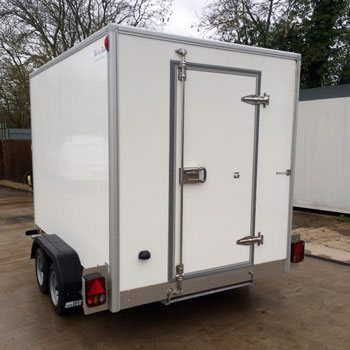
The trailers we rent are German-engineered, easy to transport, have 9’3’’ x 6’0’’ x 6’6’’ of space, lock up securely and offer non-slip surfaces for safety. They can be towed by pretty much any van or 4×4 vehicle and provide a lot of cooling space in a small form factor. Add in a set-up service and a 24-hour emergency call line and that’s a lot of peace of mind for so little outlay. These extra services can help prevent your event from turning into a storied disaster.
Cold Storage Trailer Hire for Overflow Capacity
A business may be capable of completing the work but lack the refrigerated space to hold the necessary ingredients, finished products or incoming stock.
A trailer can provide that missing capacity.
Positioned outside the premises, it effectively becomes an extension of the existing refrigeration facilities. Less frequently used products or bulk deliveries can be moved into the trailer, freeing space inside the main cold room for daily production and fast-moving stock.
This can help a business accept additional work without committing to a permanent expansion that may not be justified during quieter months.
Temporary refrigerated storage is also useful when stock arrives in concentrated batches. Suppliers may deliver larger quantities to reduce transport costs or prepare for a period when deliveries will be restricted. Without additional refrigeration, that stock can create an immediate bottleneck.
A trailer provides somewhere secure and organised to hold it until it is needed.
Emergency Fridge Trailer Hire
An emergency fridge trailer hire can provide temporary storage while the existing refrigeration system is repaired or replaced.
Once delivered, positioned and brought to the required temperature, stock can be transferred from the failed unit. This can prevent avoidable waste and help the organisation continue operating.
The consequences of losing refrigeration often extend beyond the value of the products themselves. A restaurant may have to cancel bookings. A food manufacturer could miss an important order. A retailer might be unable to replenish its displays, while a hotel or event caterer could be left without ingredients for a major function.
Temporary refrigerated storage gives the business time to make sensible repair decisions rather than accepting the first available solution because stock is deteriorating.
Refrigerated trailer hire can also support planned maintenance. A cold room may need cleaning, refurbishment, replacement or an equipment upgrade. Providing temporary storage allows that work to be completed properly without bringing normal operations to a halt.
Refrigerated Trailer Hire for Seasonal Demand
Christmas, Easter and other major trading periods bring sharp increases in demand for food manufacturers, butchers, retailers, hotels, restaurants and catering businesses. Valentine’s Day and Mother’s Day can create similar peaks for florists, restaurants and specialist retailers.
During these periods, permanent refrigeration may be filled long before the busiest day arrives. Hiring a refrigerated trailer in advance provides controlled additional capacity without forcing the business to overload existing equipment or store goods in unsuitable areas.
Planning should begin by reviewing what happened during previous peak periods. Consider when stock levels were at their highest, which products occupied the most space and how long the pressure lasted. It is also useful to assess whether staff could access products easily or whether an overcrowded cold room slowed down the operation.
This information will help establish when the trailer should arrive and how much additional capacity is likely to be needed.
Booking early is particularly important where the seasonal peak is shared by many businesses. Refrigerated trailers are naturally in greater demand during Christmas and the summer event season. Leaving the arrangement until the last moment may limit availability and make delivery more difficult to coordinate.
Seasonal refrigerated trailer hire allows a business to scale up temporarily without carrying the cost of unused capacity throughout the rest of the year.
Refrigerated Trailer Hire for Events
Temporary refrigeration is a fundamental part of event planning, even though it is sometimes considered later than marquees, bars, furniture and entertainment.
A caterer can have an excellent menu and an experienced team, but the operation still depends on having somewhere suitable to store the ingredients.
Outdoor venues often have limited permanent refrigeration. Some have none at all. Refrigerated trailer hire creates a temporary cold room close to the catering area, allowing food and drinks to remain on site without relying on repeated deliveries or long journeys back to a commercial kitchen.
This improves control as well as convenience. Staff know where stock is located, can organise it before service and retrieve products as they are needed.
Fridge trailers are regularly hired for:
- Weddings and private celebrations
- Music and food festivals
- Concerts
- Agricultural shows
- Sporting events
- Christmas markets
- Corporate functions
- Exhibitions
- Community events
- Mobile catering and bar areas
At a large event, more than one trailer may be appropriate. Chilled ingredients, frozen products and drinks may need to be stored separately, particularly where different catering teams are working across the site.
Separating the stock can make it easier to manage and reduce the amount of time staff spend searching inside the unit.
The trailer needs to be included in the event’s wider logistics plan. Delivery, positioning, electrical supply and access should be coordinated with marquees, catering equipment, generators and other contractors.
A trailer that arrives after the food delivery has limited value. Equally, placing it before the site layout has been finalised may result in it being positioned where it obstructs another part of the operation.
Fridge Trailer Hire for Weddings and Private Functions
Weddings create their own practical refrigeration challenges.
Food may be prepared or delivered well before guests arrive. Drinks need to be chilled in large quantities, and the catering team may be working from a temporary kitchen inside a marquee, barn or rural venue.
The event may continue from the afternoon until late in the evening, requiring ingredients, prepared dishes, desserts, wines and soft drinks to remain properly stored for many hours.
Fridge trailer hire provides additional capacity close to the catering area without filling the temporary kitchen with refrigeration equipment.
A trailer can also help protect products that are particularly vulnerable during warm weather. Wedding cakes, chocolate decorations, desserts and floral arrangements may all need a cooler environment before they are displayed.
The proposed trailer location should be considered during the early stages of planning. It needs to be accessible to catering staff but should not obstruct guest routes, service roads or emergency access.
The ground must be suitable, and a compatible power supply should be available nearby. Trying to settle these details on the morning of the wedding creates unnecessary pressure for the venue, caterer and hire provider.
Refrigerated Trailers for Festivals and Outdoor Catering
Festivals and outdoor markets often require large quantities of food and drink to remain on site for several days.
Vendors may be working from compact temporary stands with little built-in storage. Deliveries can be restricted to certain hours, and once visitors arrive, moving vehicles through the event site may be difficult.
A refrigerated trailer allows traders to hold a larger quantity of stock close to their stand without relying on repeated deliveries.
It can also prevent smaller catering refrigerators from becoming overloaded. Under-counter units and display fridges are useful for immediate service, but they may not have enough capacity for several days’ ingredients.
The access route between the trailer and the catering area must be considered carefully. Staff may be carrying boxes, trays or containers after dark or in poor weather. Uneven ground, heavy pedestrian traffic and long distances can make an otherwise convenient trailer position impractical.
The unit should therefore be close enough to support the operation without creating a hazard or obstructing public areas.
How Does a Refrigerated Trailer Work?
A refrigeration unit removes heat from the trailer’s interior and releases it outside. Insulated walls, roof, floor and doors help prevent external warmth from entering the storage area.
The required temperature is selected through a control panel. The unit then monitors the internal conditions and operates as necessary to maintain the setting.
Cold air circulates through the interior, helping to keep the temperature consistent. This airflow is important and should be considered when the trailer is loaded. Boxes and containers packed tightly against the walls or refrigeration outlet may prevent cold air from circulating properly.
The trailer will usually operate from an external electrical supply. Once it has been positioned and connected correctly, it can provide continuous refrigeration throughout the hire period.
It is important to understand that a storage trailer is not automatically a blast chiller. Loading a large quantity of warm products places far more demand on the refrigeration system than loading goods that are already chilled or frozen.
Where possible, products should be brought to the correct temperature before they enter the trailer. The unit can then maintain that condition rather than attempting to cool an entire warm load quickly.
Chilled or Frozen Trailer Hire?
Not every refrigerated trailer has the same operating range.
Some are intended primarily for chilled storage, while others can maintain freezer temperatures. Certain units can be adjusted across a wider range, providing greater flexibility.
The correct specification depends on the products being stored.
Fresh meat, dairy products, prepared meals, fruit, vegetables, drinks and flowers may all require chilled conditions, but that does not mean they should necessarily be kept at the same setting. Frozen food and ice cream require a trailer capable of maintaining much lower temperatures.
The hire provider therefore needs more information than a general request to keep something cold.
Before booking, explain what will be stored, whether the goods are chilled or frozen and what temperature they will be when loaded. The provider should also know how often staff will enter the trailer, how long the products will remain inside and whether different stock types need to be separated.
That information allows the trailer and temperature range to be matched to the actual requirement.
Choosing The Right Refrigerated Trailer Capacity
Capacity should be based on more than the physical volume of the goods.
The trailer must have enough room for the stock, but staff also need to enter safely, organise products and retrieve them without repeatedly moving everything else.
Begin by estimating the largest volume likely to be stored at any point during the hire. Consider the packaging as well as the products themselves. Crates, boxes, trays, barrels and catering containers all occupy space differently.
A loading arrangement must also allow cold air to circulate. Filling every available gap or stacking goods tightly against the internal walls can restrict airflow and result in uneven temperatures.
Access matters too. A trailer may technically hold all the stock, but that does not make it practical if staff have to unload half the unit to reach a box at the back.
For an event or busy production site, a slightly larger trailer with a clear walkway may be more useful than a smaller unit packed to its absolute limit.
Give the hire company an honest estimate of the stock volume, packaging and expected frequency of access. This will help them recommend a refrigerated trailer that works operationally, not simply one that appears large enough on paper.
Preparing The Site for a Refrigerated Trailer
A refrigerated trailer is relatively straightforward to operate, but the delivery location needs to be suitable.
The ground should be firm, stable and reasonably level. Soft grass or unfinished ground can become problematic after heavy rain, particularly at festivals, farms and rural wedding venues.
There must also be enough space for the towing vehicle to deliver and position the trailer. A location that appears accessible on foot may be difficult to reach through a narrow gateway, tight corner or crowded service yard.
Low branches, parked vehicles, temporary structures and restricted turning areas should all be considered in advance.
The trailer should be close enough to the working area to be useful, but it must not obstruct entrances, loading bays, pedestrian routes or emergency access.
A compatible electrical supply must also be available within an appropriate distance. The exact requirement should be confirmed with Northgate Temperature Controlled before delivery. Improvised connections and unsuitable extension leads can create reliability and safety problems.
Where a generator is being used, it needs to provide the correct output and run consistently for the full hire period. Fuel arrangements should be planned carefully. A generator that stops overnight may leave the trailer without refrigeration for several hours before anyone notices.
Loading And Operating a Fridge Trailer
Good working habits help the trailer maintain temperature and make it easier for staff to use.
The door should remain closed whenever possible. Every opening allows warm air to enter, particularly on hot days. Repeatedly leaving the door open while stock is selected or moved makes the refrigeration system work harder and may affect the internal conditions.
Plan the layout before loading. Products required first should be positioned where they are easy to reach, while longer-term stock can be placed further back.
Goods should not block the refrigeration unit or interfere with airflow. Enough floor space should also remain clear for staff to move around safely.
Loose packaging, spills and unstable stacks can quickly become hazards in a cold, enclosed environment. Any problems should be dealt with promptly rather than left until the end of the hire.
At an event, it is sensible to give one person responsibility for the trailer. Without clear control, several teams may rearrange stock, leave doors open or use space that was intended for another part of the catering operation.
A basic stock plan and clear control of the keys can prevent much of this confusion.
Hygiene and Stock Separation
A refrigerated trailer becomes part of the business’s food-storage environment and should be managed with the same care as a permanent cold room.
Products should be packaged to prevent leakage and contamination. Raw ingredients and ready-to-eat foods need to be separated in accordance with the organisation’s normal food-safety procedures.
Spills should be cleaned promptly. Hard-wearing, non-slip flooring and washable internal surfaces make cleaning easier, but they do not replace routine housekeeping.
Where specialist products are being stored, the intended use should be discussed with the hire provider. Allergens, strong odours and sensitive materials may require additional consideration.
At the end of the hire, all stock and packaging should be removed, and the trailer should be returned in the condition agreed with Northgate Temperature Controlled.
Security and Stock Protection
Temporary cold storage often contains valuable stock.
This is particularly relevant at festivals, markets and public events where the trailer may be positioned in an area accessible to contractors, event staff or visitors.
A suitable trailer should provide secure doors and robust locking arrangements. Coupling security also helps protect the unit itself while it remains on site.
The location can improve security. A well-lit position close to the operating area is generally preferable to an isolated corner of the venue.
Access to the keys should be controlled. Leaving them in a shared kitchen, office or bar area makes it difficult to know who has entered the trailer.
For longer refrigerated trailer hire periods, regular stock checks can help identify damaged packaging, missing goods or poor loading practices before they lead to larger problems.
Refrigerated Trailer Energy Use
A refrigerated trailer uses electricity, but its energy consumption is influenced by the way it is built and operated.
Effective insulation reduces the amount of external heat entering the trailer. Modern refrigeration technology can also help the unit maintain the required temperature efficiently.
External conditions will still have an effect. The refrigeration system needs to work harder during hot weather, when the door is opened frequently or when warm stock is loaded.
Where the site layout allows it, avoiding unnecessary heat exposure may help. However, firm ground, safe access, a reliable power supply and sufficient ventilation around the refrigeration equipment remain the main priorities.
Efficient loading also makes a difference. Pre-chilled products, sensible stock organisation and good door discipline allow the unit to operate more steadily.
This does not mean the trailer should be completely full. Cold air still needs room to circulate. The aim is to use the space effectively without obstructing airflow.
Should You Hire or Buy a Refrigerated Trailer?
Buying a refrigerated trailer may make sense for an organisation that requires additional storage throughout the year and has the facilities to maintain, move and store it.
For occasional, seasonal or emergency requirements, hiring is usually more practical.
Ownership involves a significant initial cost as well as servicing, repairs, electrical checks, insurance and storage. Refrigeration equipment cannot simply be parked for most of the year and expected to operate perfectly when it is eventually needed.
Refrigerated trailer hire transfers much of that responsibility to the provider. The business receives a suitable trailer for the required period and returns it once the job is complete.
It also provides access to different specifications as circumstances change. A business can hire a small chilled trailer for one event and a freezer-capable unit with greater capacity for another.
This flexibility is often more valuable than owning equipment that is either too large for ordinary requirements or too small during the busiest periods.
What To Ask Before Hiring a Refrigerated Trailer
A specialist refrigerated trailer hire company should take time to understand how the unit will be used.
Before booking, confirm the operating temperature range, internal dimensions, power requirements and delivery access.
You should also establish whether delivery, positioning and collection are included, how quickly the unit can reach the selected temperature and what support is available if a problem occurs.
Ask about security, temperature monitoring and cleaning responsibilities. Most importantly, confirm that the trailer is suitable for the specific products being stored.
Emergency support is particularly important. Refrigeration problems do not always happen during normal office hours, and a fast response can make a considerable difference when valuable stock is involved.
Cost is naturally part of the decision, but the cheapest quotation does not always present the lowest overall risk. A trailer that cannot reach the site, needs a different power connection or is unsuitable for the intended goods can create delays and losses that far exceed any initial saving.
Why Choose Northgate Temperature Controlled for Refrigerated Trailer Hire?
“At FridgeXpress, we understand that each client has unique requirements. That’s why we focus on providing refrigerated trailers that are specifically adapted to meet those precise needs, ensuring optimal conditions for the cargo at every stage of the journey.” Operations Director, Craig Diaz
Temporary refrigeration involves more than delivering a trailer and connecting it to electricity.
The unit must suit the products, available space, required temperature, electrical supply and expected level of access. Delivery must also be coordinated so the trailer is positioned and ready before the stock arrives.
Northgate Temperature Controlled specialises in refrigerated vehicles and mobile temperature-controlled solutions. This focused experience allows our team to help customers assess what they need rather than leaving them to choose equipment without guidance.
Our refrigerated trailers are designed to provide dependable chilled or frozen storage for businesses, events and temporary operations. They combine effective insulation, robust construction, secure access and practical internal space.
We can also assist with delivery, positioning and setup, which is particularly useful for customers arranging fridge trailer hire for the first time.
Whether the requirement has been planned months in advance or caused by an unexpected equipment failure, the objective is the same: protect the stock and keep the operation moving.
Arrange Refrigerated Trailer Hire
If your business needs additional chilled or frozen storage, contact Northgate Temperature Controlled to discuss refrigerated trailer hire for your dates, products, site access and temperature requirements.
