
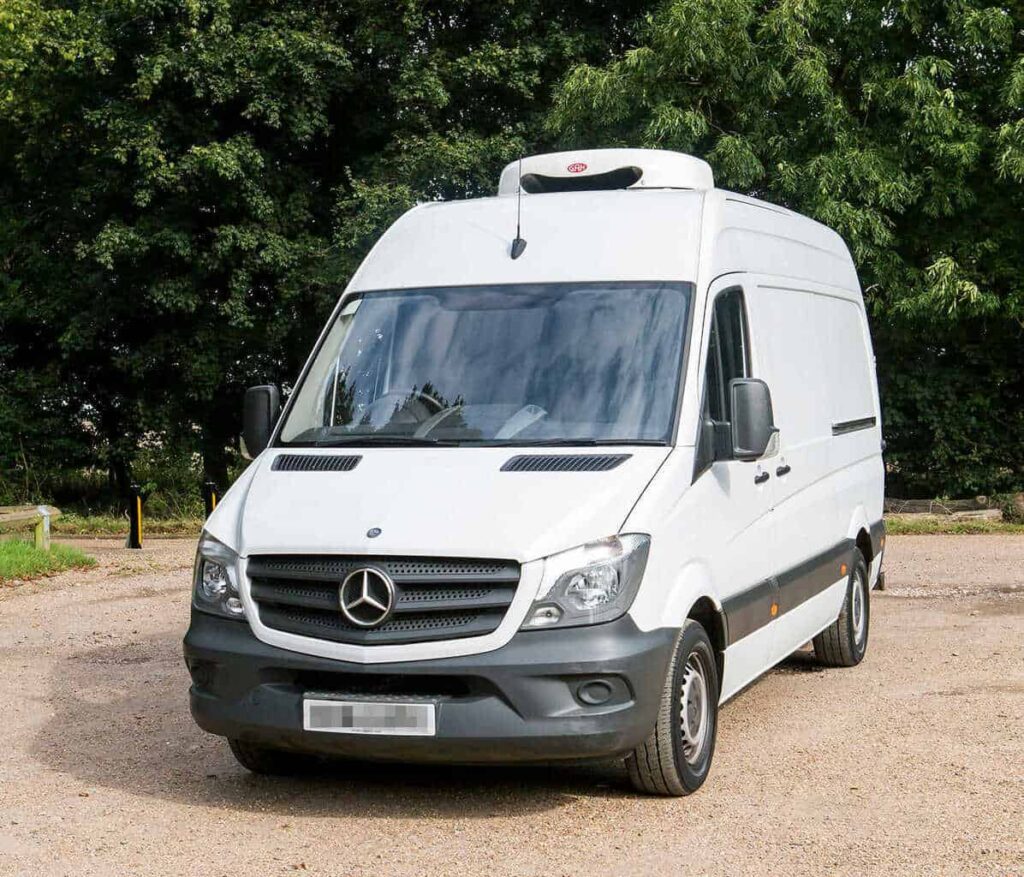
There is a reason the Mercedes-Benz Sprinter has become such a familiar sight in commercial fleets.
It is a proper working van. There is plenty of load space, numerous body configurations, a cab designed for drivers who may spend most of the day behind the wheel and enough flexibility to adapt the vehicle for very different types of work.
That flexibility is particularly useful when the Sprinter is converted into a refrigerated van.
Temperature-controlled transport rarely works well with a one-size-fits-all approach. A catering company carrying prepared food has different requirements from a butcher transporting fresh meat. A frozen food distributor may need a lower operating temperature, while another business might need separate chilled and frozen compartments within the same vehicle.
The Mercedes Sprinter provides a strong starting point for all of these applications.
Northgate Temperature Controlled currently offers several Sprinter configurations, ranging from medium wheelbase refrigerated vans to larger extra-long-wheelbase models and a specialist dual-evaporator conversion. Together, they show why the Sprinter remains such a useful platform for businesses that depend on chilled and frozen transport.
In this Mercedes Sprinter refrigerated van review, we look at what makes the model work so well, the different configurations available and which businesses are likely to benefit from each version.
The Mercedes-Benz Sprinter: A Proven Commercial Van
The Sprinter first appeared in the mid-1990s and has since developed into one of Mercedes-Benz’s core commercial vehicles.
Its longevity matters. Refrigerated fleet operators are not looking for novelty. They need a vehicle platform that can cope with daily mileage, repeated loading and unloading, demanding delivery schedules and the added weight and complexity of a refrigerated conversion.
The current Sprinter Panel Van is available from Mercedes-Benz in three vehicle lengths and two heights, with load-floor lengths extending to 4,810mm depending on configuration. Mercedes also offers numerous body and drivetrain options, which gives converters considerable freedom when designing a vehicle around a particular operation.
That adaptability is one of the Sprinter’s biggest strengths as a refrigerated van.
A business does not have to choose between a tiny urban delivery van and an oversized box vehicle. Different wheelbases and refrigeration layouts allow the Sprinter to occupy the useful middle ground between the two.
Why Does the Sprinter Work So Well as a Refrigerated Van?
Refrigerating a commercial van changes it considerably.
Insulated panels reduce the internal dimensions. Refrigeration equipment adds weight. Evaporators, bulkheads, floor protection, temperature recording equipment and load-restraint systems all take up space.
The base vehicle therefore needs enough capacity to absorb those changes without becoming impractical.
The Sprinter does this particularly well.
Its relatively tall, square cargo area provides a good starting point for insulation, while the choice of body lengths allows a refrigerated conversion to be matched more closely to the volume of goods being carried.
It is also possible to create more specialised layouts. Northgate’s current fleet includes conventional single-temperature refrigerated Sprinters as well as a long-wheelbase dual-evaporator version designed for more complex temperature-controlled work.
This makes the Sprinter useful across catering, food distribution, meat and seafood transport, pharmaceutical logistics and other operations where dependable temperature control matters every day.
A Refrigerated Van is More Than a Cooling Unit
The refrigeration system naturally gets most of the attention, but a good refrigerated Sprinter relies on the complete conversion.
Insulation is fundamental. Without an effective thermal barrier around the cargo space, the refrigeration unit has to work harder to compensate for heat entering through the body.
The floor needs to withstand regular loading, spills and cleaning. Doors have to maintain their seal despite being opened repeatedly throughout a delivery route. The internal finish needs to be durable and appropriate for the products being transported.
Northgate’s Sprinter conversions illustrate how these elements come together.
Depending on the particular model, specifications can include 75mm insulated panel systems, non-slip flooring, insulated doors, thermal curtains, drainage, LED lighting, load tracks and temperature recording equipment. Refrigeration units with electric standby are also available on relevant vehicles. (Northgate Temperature Controlled)
These details may sound secondary when choosing a van, but in day-to-day operation they make a considerable difference.
Chilled and Frozen Sprinter Vans
One of the advantages of a properly converted Mercedes Sprinter refrigerated van is its temperature range.
Northgate’s current Sprinter MWB conversion uses a GAH SR351F refrigeration unit specified for a range from -20°C to +20°C. The XLWB model uses a GAH SRF351 unit with a listed range from -18°C to +20°C.
That provides considerably more versatility than a vehicle intended solely for mild chilled conditions.
Businesses still need to select a van according to the product being transported. A refrigerated vehicle designed to maintain chilled food is not automatically suitable for every frozen, pharmaceutical or specialist load.
Products should also normally be loaded at the correct transport temperature. The refrigeration system is principally there to maintain that condition during the journey rather than act as a substitute for a commercial blast chiller or freezer.
For businesses carrying several product categories, a more specialised multi-temperature Sprinter may be preferable.
Driver Comfort Matters More Than It Sounds
Refrigerated vehicle selection often concentrates almost entirely on the rear of the van.
That is understandable, because protecting the cargo is the reason the vehicle exists. But someone still has to drive it.
For a business running daily delivery routes, cab comfort and driver assistance can influence productivity, fatigue and how pleasant the vehicle is to operate.
Northgate’s Sprinter fleet includes features such as cruise control, keyless start, Bluetooth, DAB, Apple CarPlay and Android Auto on relevant models.
The current-generation Sprinter platform also benefits from Mercedes-Benz safety technology. Mercedes lists systems including Active Brake Assist with cross-traffic function, Active Lane Keeping Assist, Intelligent Speed Assist, a reversing camera and Crosswind Assist on the current Sprinter Panel Van. The model received a five-star Euro NCAP commercial van safety rating in 2025.
None of this changes the temperature of the load, but it matters when a vehicle is spending five or six days a week on the road.
Who is a Mercedes Sprinter Fridge Van Best Suited To?
The Sprinter is especially attractive to businesses that have outgrown smaller refrigerated vans but do not necessarily need a large refrigerated truck.
Foodservice distributors are an obvious example. A Sprinter provides enough internal capacity to handle meaningful delivery volumes while remaining more manageable than a larger rigid vehicle.
Caterers can use the space for trays, boxed ingredients and prepared products. Butchers and meat suppliers can specify interiors suited to their particular loading requirements. Frozen food businesses can choose suitable low-temperature conversions, while multi-temperature configurations can help companies moving chilled and frozen goods on the same route.
It can also work well for businesses operating nationally.
The Sprinter is large enough for substantial loads without becoming unnecessarily cumbersome for ordinary commercial delivery work. That balance is one of the main reasons it has remained so popular.
Mercedes-Benz Sprinter MWB Refrigerated Van Review
The Mercedes-Benz Sprinter MWB is arguably the most versatile option in the current Northgate Sprinter range.
It provides a 10m³ load volume and a listed payload of 900kg. The refrigerated load area measures 3,105mm in length, with a panel-to-panel width of 1,590mm and maximum load height of 1,715mm.
That puts it in a useful position for businesses that need meaningful refrigerated capacity without moving into one of the longest vans on the road.
The conversion is comprehensive. It includes 75mm insulated panels, insulated side and rear doors, a non-slip floor, thermal curtains, load tracks and a Seven Transcan temperature recorder. The GAH refrigeration unit has electric standby and a specified operating range of -20°C to +20°C.
Where the MWB Works Best
This is the Sprinter I would look at first for general refrigerated delivery work.
The 10m³ capacity is substantial enough for food distribution, catering, meat, seafood and larger multi-drop operations without creating the footprint of an extra-long vehicle.
The 900kg listed payload also gives a useful indication of how much working capacity remains after the refrigerated conversion, although operators should always calculate their actual load carefully.
For a business moving between town centres, restaurants, commercial kitchens and depots, the MWB provides a sensible compromise between capacity and manoeuvrability.
Best suited to: general food distribution, catering, meat and seafood suppliers, regional multi-drop work and businesses moving up from a smaller fridge van.
Find out more about the Mercedes-Benz Sprinter MWB Refrigerated Van
Mercedes Sprinter LWB Dual-Evaporator Refrigerated Van Review
The Mercedes Sprinter LWB Dual-Evaporator is the more specialised proposition.
Its headline feature is the GAH SRD351-FLEXI dual-evaporator system. The conversion also incorporates a load-lock rail for a bulkhead, along with the equipment needed to create a more flexible refrigerated load area. (Northgate Temperature Controlled)
This matters for businesses whose transport needs are more complicated than simply maintaining one open cargo space at a single temperature.
A specialist multi-compartment or flexible refrigeration setup can be valuable when products with different temperature requirements need to travel on the same route.
The current Northgate model has a listed 10m³ load volume and an 852kg payload. Its conversion includes 75mm insulated panels, a high-resistance non-slip GRP floor, metal upstands, checker-plate wheel boxes, a pallet-width side slab door, a Transcan printer and electric standby capability. (Northgate Temperature Controlled)
Where The LWB Dual-Evaporator Works Best
This is not simply a bigger version of the MWB.
Its attraction lies in the refrigeration configuration and interior specification.
For foodservice suppliers carrying varied stock, more sophisticated catering operations or businesses that need greater flexibility in how the load space is managed, the dual-evaporator Sprinter has a clear advantage.
The pallet-width side door can also make a practical difference where larger items or organised bulk loads need to be moved efficiently.
Best suited to: multi-temperature distribution, foodservice operations, complex chilled and frozen loads and businesses requiring greater flexibility within one van.
Find out more about the Mercedes Sprinter LWB.
Mercedes-Benz Sprinter XLWB Refrigerated Van Review
When volume becomes the priority, the Mercedes-Benz Sprinter XLWB moves things up considerably.
Northgate lists a 14m³ load volume, compared with 10m³ for the MWB refrigerated model. The internal load length extends to 4,050mm, while the panel-to-panel width remains 1,590mm and maximum load height is 1,715mm.
Its listed payload is 850kg.
That difference between load volume and payload is worth noting. An extra-long van provides substantially more physical space, but that does not mean operators can simply keep loading until the cargo area is full. Lightweight but bulky goods may make excellent use of the additional volume, whereas dense loads must be planned around the vehicle’s permitted weight.
The XLWB conversion includes 75mm insulation, non-slip flooring, rear and side curtains, modular rear doors, bulkhead load rail, LED lighting, a Transcan printer and a GAH refrigeration unit capable of operating across a listed -18°C to +20°C range.
Where The XLWB Works Best
The extra length makes this version particularly useful where the problem is physical volume rather than extreme weight.
Large catering operations, bakery distribution, prepared foods, packaged chilled products and businesses carrying a high number of relatively light boxes can make particularly good use of the space.
It may also allow some companies to complete a route with one vehicle where a smaller van would require an additional journey.
The trade-off is obvious. At almost seven metres overall, the XLWB demands more thought around parking, turning and access. Businesses making repeated drops into cramped town centres may find the MWB easier to live with.
For trunk routes, larger deliveries and high-volume distribution, however, the XLWB becomes a compelling refrigerated Sprinter.
Best suited to: high-volume refrigerated loads, major catering operations, wholesale distribution and routes where maximum cargo space matters more than compact dimensions.
Find out more about the Mercedes-Benz Sprinter XLWB.
Mercedes-Benz Sprinter Van and Luton Configuration
Northgate also lists a Mercedes-Benz Sprinter Van based on an L3 316 CDI Progressive single-cab Luton with a tail lift.
It is worth making an important distinction here. The current vehicle page classifies this particular configuration as non-refrigerated, despite sitting within the wider Northgate vehicle catalogue.
It therefore should not be treated as an alternative refrigerated conversion to the MWB, XLWB and dual-evaporator vans above.
What it does demonstrate is the broader flexibility of the Sprinter platform.
The listed vehicle has a 4,050mm load length, 2,050mm panel-to-panel width and maximum load height of 2,184mm, with an 892kg payload. It also incorporates features such as Active Brake Assist, Crosswind Assist, cruise control, an MBUX touchscreen and smartphone integration.
For businesses assessing Mercedes Sprinter body configurations more broadly, it provides a useful example of how the chassis can support larger specialist bodies and tail-lift applications.
If a temperature-controlled Luton or specialist-bodied Sprinter is required, the conversion would need to be specified accordingly rather than assuming this particular vehicle is refrigerated.
View the current Mercedes-Benz Sprinter Van specification from Northgate Temperature Controlled.
Mercedes-Benz Refrigerated Vans
Although the Sprinter is the obvious focus when discussing larger Mercedes-Benz refrigerated vehicles, it sits within a broader commercial vehicle range.
Northgate Temperature Controlled offers Mercedes-Benz refrigerated vehicles for cold-chain operations across food service, pharmaceutical distribution, healthcare logistics, catering and other specialist sectors. The current range includes different Sprinter wheelbases and refrigeration configurations, allowing vehicle choice to be based on delivery volume, temperature requirements and route conditions rather than the badge alone.
That is important because there is no single ideal Mercedes-Benz refrigerated van.
The right vehicle is the one that fits the work. For some businesses that will mean the flexibility of the MWB Sprinter. Others will need the additional volume of the XLWB or the more specialised capabilities of the dual-evaporator model.
Northgate’s wider Mercedes-Benz range can be viewed here.
Safety and Technology
Commercial van technology has moved on significantly from the earlier Sprinters many fleet operators remember.
The current Sprinter Panel Van offers an MBUX multimedia system and a range of digital functions, alongside driver-assistance technology intended to make daily commercial operation easier.
Mercedes-Benz currently lists Active Brake Assist with cross-traffic function, Active Lane Keeping Assist, Intelligent Speed Assist, reversing camera and Crosswind Assist among the standard assistance features on the UK Sprinter Panel Van.
For refrigerated fleets, these features are not merely about creating a more luxurious van.
Drivers may cover considerable mileage, enter crowded delivery areas and manoeuvre around restaurants, shops, loading bays and distribution centres throughout the day. Anything that reduces fatigue or helps the driver manage the vehicle more confidently has practical value.
What About Running Costs?
The old assumption that a bigger van is automatically uneconomical is too simplistic.
Running cost depends on the exact specification, route, driving style, load, refrigeration demand and amount of time spent in urban traffic.
Mercedes-Benz currently quotes a broad combined fuel-consumption range for the Sprinter Panel Van because performance varies significantly between configurations. Smaller versions naturally tend to consume less fuel than larger and heavier specifications
A refrigerated conversion adds another consideration. The refrigeration system requires energy, and the amount of work it needs to do depends partly on outside temperature, door-opening frequency, insulation and the temperature of the products being loaded.
Vehicle size should therefore be matched sensibly to the work.
Running a large XLWB almost empty every day makes little commercial sense if an MWB could comfortably handle the load. Equally, choosing a smaller van and making two journeys instead of one can wipe out the expected saving.
The most efficient vehicle is usually the one that matches the route and payload properly.
Mercedes Sprinter Refrigerated Van Review: Our Verdict
The Mercedes-Benz Sprinter has lasted as a commercial favourite because it occupies a very useful position in the market.
It offers serious load capacity without automatically pushing a business into a larger truck. The choice of body lengths provides scope to match the vehicle to different delivery operations, while the underlying platform supports everything from straightforward chilled conversions to dual-evaporator systems and more specialist bodies.
For general refrigerated delivery work, the MWB is probably the strongest all-rounder. It combines a useful 10m³ volume with a 900kg listed payload and a wide temperature range.
For businesses carrying more complicated loads, the LWB Dual-Evaporator offers greater refrigeration flexibility.
Where load volume is the overriding concern, the 14m³ XLWB provides substantially more room without abandoning the familiar Sprinter platform.
That variety is ultimately the Sprinter’s greatest strength.
There is no single Mercedes Sprinter fridge van that suits every business. Instead, the platform can be adapted around the way the business actually works.
Choose a Mercedes Sprinter With Northgate Temperature Controlled
A refrigerated vehicle has to do considerably more than drive reliably from A to B.
The refrigeration unit, insulation, payload, internal dimensions, access and temperature monitoring all need to suit the products being transported.
Northgate Temperature Controlled specialises in refrigerated vehicles and can help businesses compare the different Mercedes Sprinter configurations according to their actual operating requirements.
Whether you need additional capacity for a short period, a longer-term refrigerated van hire arrangement or a specific Sprinter configuration for regular cold-chain work, the starting point should be the same: understand the load, the temperature and the route.
